
The 98 Listings Problem
A speculative research project I built to understand why finding an apartment in one of Brazil's most vibrant cities was still so unnecessarily hard, and what a growing proptech could do about it.
This was an independent project I developed in 2021 to pitch a position at QuintoAndar. I ended up being hired elsewhere, but the research stands on its own. QuintoAndar has since scaled significantly across Brazil and is now widely considered one of the country's most successful proptech companies, which makes some of these early findings all the more interesting to look back on.
The Problem Worth Investigating
Finding a long-term rental in Brazil involves a level of bureaucracy that surprises most people encountering it for the first time. Landlords typically require a guarantor — someone who owns property in the same city and can co-sign the lease — which immediately excludes anyone new to town. Security deposits are common. Real estate agencies charge fees while taking on little responsibility for what happens after the contract is signed.
QuintoAndar was built to solve exactly this. The model: a digital platform connecting tenants and landlords directly, with no need for a guarantor or security deposit, insurance built in, and a streamlined rental process. No agency in the middle. Just a platform, a contract, and coverage if something goes wrong.
In August 2021, QuintoAndar had been operating in Recife for just six months. They had 98 listings. For a city of 1.6 million people, that's a thin foothold — and I wanted to understand why.
What we Knew, What we Assumed
& What we Needed to Find Out
Certainties
Young adults are motivated to leave the family home . Independence is the goal, not just the address
Tools vary by region, but the rental process feels the same everywhere, slow and opaque
Landlords rarely manage their own listings directly
Property owners care more about maintenance than vacancy
Suppositions
Finding a good fit is hard: not just practically, but emotionally
Women weigh personal safety heavily when evaluating listings
Pandemic-era cabin fever accelerated the desire to move out and live independently
Listings rarely give people enough information to make a confident decision
Doubts
What is the real cost (in time, stress and money) of finding the right place?
Does location still matter as much as it did before remote work became normal?
Where in Recife are people actually searching for apartments?
Do listings reflect what tenants actually find when they show up?
What Tenants Actually Want
I interviewed 12 people who had recently searched for an apartment in the Recife area, working from a CSD Matrix (Certainties, Suppositions and Doubts) to structure what I knew, what I was assuming, and what I needed to find out.The findings complicated the picture.
Young professionals valued location even when working remotely, but were more open to different neighborhoods than listings platforms typically assumed. The top five motivators for moving were independence, privacy, freedom, peace and escaping family conflict. The main tools people used were OLX and Zap, both essentially classified boards, efficient for discovery but completely absent from the process once a lease was signed.
Two comments from interviews stood out:
"Realtor's service is extremely bad: lack of responses, poor knowledge, outdated advertisements. Real estate agencies only serve as an intermediary and don't accept any responsibility for delays. The monthly fee feels like just a bank slip."
"More often than not, there isn't enough time to visit many places, and the available photos aren't good. It doesn't help trying to filter places to help make an informed decision."
QuintoAndar wasn't mentioned once by any interviewee. Not because people didn't want what it offered, but because they simply didn't know it existed in Recife yet.
Where Tenants Look
83%
OLX
17%
VivaReal
42%
ZAP imóveis
17%
Newspaper
75% said their job location weighted in their decisions
58% were open to exploring alternative neighborhoods
Time to close a deal
The cost of the process varied considerably and was mainly driven by the cost of internet connections and transportation to view listings
How About Landlords?
The other side of the equation was just as revealing. I built a second CSD Matrix focused on landlords, surveyed a separate group, and followed up with an informal interview with a local realtor.
The assumption baked into QuintoAndar's marketing materials was that landlords' primary concern was timely rent payments. The research said otherwise. What landlords in Recife cared most about was property maintenance and repairs, knowing that if something broke, it would be handled. QuintoAndar actually offers insurance coverage up to R$50,000 for exactly this, but that benefit wasn't being communicated prominently to the people it would matter most to.
A few other things emerged from the realtor conversation that were harder to quantify but important to understand. Property owners in Pernambuco tend toward caution in business dealings (they want familiarity), a real person to call, not a chatbot or a generic support email.
And local realtors were actively resistant to the platform, not out of laziness, but out of a clear-eyed understanding of what QuintoAndar represented. This wasn't a new tool for realtors to use. It was a model designed to make their role unnecessary altogether, speaking directly to property owners and handling everything the agency used to manage. The proposition was disintermediation, full stop. At the time of this study, no real estate agency in Recife had partnered with the platform, and that resistance was one of the key reasons listings were so thin on the ground.
The other side of the table — Certainties, Suppositions and Doubts
Certainties
Without a local office or dedicated agent, QuintoAndar reads as less accountable, not just less familiar
Real estate agents handle the listing but disappear after the deal closes, leaving landlords without ongoing support
Would landlords prefer to handle contracts themselves if the process were simpler?
Recife’s average rental prices are lower than São Paulo’s, making the market commercially attractive but harder to crack
QuintoAndar’s adoption in Recife was still thin. The platform hadn’t yet earned local trust
Suppositions
Landlords prefer established payment methods like bank transfers over newer ones like Pix: familiarity signals security
Older landlords are more likely to distrust a fully digital business model with no physical presence
Doubts
Which platforms do landlords use to post listings and what keeps them there?
Do landlords actually trust real estate agents to manage their listings or just tolerate them?
Would landlords accept insurance or guaranteed rent in place of the standard three-month deposit?
What are the real dealbreakers for landlords when evaluating a new tenant?

OUR PERSONAMrs. Augustina
Retiree, 65 years old
Her rental income isn’t supplemental, it’s what she lives on, alongside her pension
Owns 4 rental units, all managed through a realtor she’s worked with for years
Collects rent via bank transfer and payment slips, methods she knows and trusts
Her biggest fear isn’t vacancy. It’s damage she can’t see coming
“I call my agent every week just to make sure nothing has gone wrong with my properties.”
What Can Be Done About It?
The recommendations I developed weren't about disrupting the existing process, they were about making QuintoAndar legible to the market it was trying to enter. Specifically: speaking to property owners in the language of their actual concerns, not the concerns the platform assumed they had.
The most immediate gap was in how the platform communicated its value to landlords. QuintoAndar was sending new landlord sign-ups a sequence of five emails in the first two weeks. Two of them led with urgency around renting quickly. Only one addressed something a landlord in Recife actually cared about: guaranteed payments. None addressed property maintenance, a real concern.
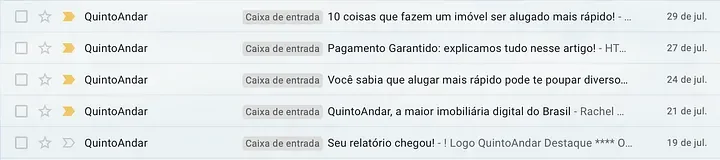
A simple resequencing of that communication, leading with maintenance coverage and property protection rather than speed-to-rent, would have better matched what the research showed landlords needed to hear. Alongside that, a service blueprint revision to strengthen the human touchpoints would have addressed the trust gap the research kept surfacing: landlords in this market want to know there's a real person accountable when something goes wrong, not just a platform.
Click to expand. Service blueprint mapping the full QuintoAndar customer acquisition journey, from first contact to rent collection.
The Takeaway
The northeast of Brazil has its own rhythm, its own speech, its own way of doing business. A platform that works beautifully in São Paulo doesn't automatically translate to Recife by switching on the service and waiting for listings to accumulate.
What QuintoAndar had built was genuinely good. The model was sound, the product was solid, and the problem it was solving was real. What was missing in 2021 was a deeper understanding of the specific market it was entering: the particular concerns of Recife landlords, the cultural preference for human relationships over digital convenience, and the need to communicate its value proposition in terms that actually landed with the people whose properties it needed on the platform.
That gap between a good product and a well-understood market is almost always a research and communication problem. Which is exactly the kind of problem worth designing for.